

The AI Industry's Revealed Preference for a State Patchwork

When critics dismiss Americans’ stated concern about online privacy, they often invoke revealed preferences. Voters say they care about privacy, then use TikTok and Gmail anyway and refuse to pay a premium for privacy-focused services to avoid data collection.
The same lens should examine the tech companies themselves. They tell Washington that the proliferation of state laws regulating AI products is an existential threat. Their advocacy suggests otherwise.
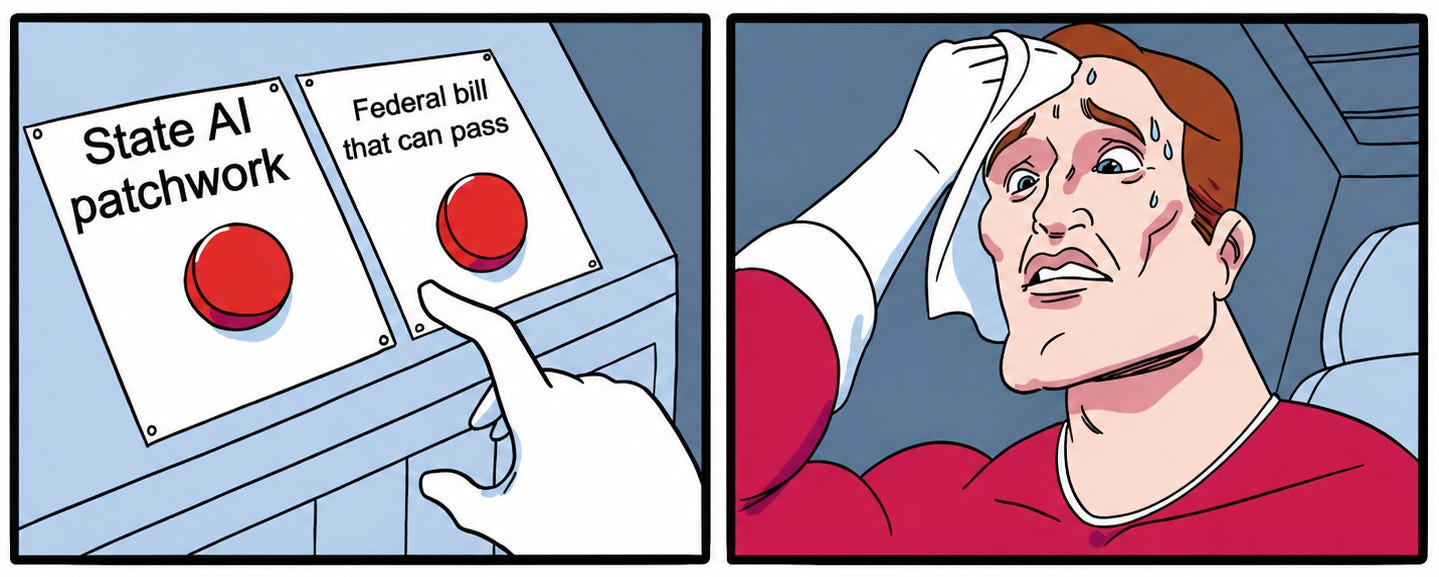
Consider the fight over a federal AI framework—and the moratorium on state AI laws that industry advocates spent the first half of 2025 trying to ram through Congress.
An important caveat: the AI industry isn’t monolithic. But there’s a broad consensus among influential voices in the AI industry that the emerging patchwork of state AI laws is a serious threat to American AI leadership. If that’s right, the rational response would be to accept meaningful federal substance in exchange for preemption. Instead, the opening play was an attempt to ban state regulation of AI for ten years while offering nothing federal in return.
That effort came close, but it died 99-1 in the Senate in July 2025 after Senator Marsha Blackburn pulled out of a negotiated compromise, introducing an amendment to strip the language herself. Her floor speech indicted Congress’s decades-long inaction on Internet policy: lawmakers hadn’t legislated on digital privacy, children’s safety, or deep fakes. The states had. Preempting them meant preempting the only legislative action actually happening.
The moratorium attempt complicated future negotiations. Indeed, a federal AI framework with real preemptive effect needs buy-in from skeptics of AI acceleration—congressional Democrats, populist Republicans, child safety groups, and economic sectors worried about job disruption. It’s hard to pivot from an opening position of railroading the states while promising, dubiously, that this Congress will eventually fill a vacuum of its own making. The industry now wants to negotiate, but it hasn’t yet made a viable offer, and distrust sown by the moratorium gambit remains.
If the patchwork were really as damaging as many claim, the path forward would be obvious: walk back the absolutist position significantly, name concrete federal guardrails industry would accept, and trade them for preemption. That largely hasn’t happened.
Rather, many leading AI voices cheered a December 2025 White House executive order directing the Justice Department to litigate against state AI laws—just five months after the moratorium failed. Prominent advocates for a national standard slammed California’s SB 53, even though the bill is relatively light touch: large developers must disclose safety protocols, protect whistleblowers, and report critical safety incidents. Notably, some AI optimists supported the bill and suggested it could be a template for federal legislation.
Some influential preemption advocates argue that state AI laws per se violate the Constitution’s Commerce Clause and that existing federal law—fraud statutes, civil rights law, consumer protection—are sufficient to address AI-specific harms. That posture may reveal the true preference: no new regulation at all, but with the patchwork as a fallback.
The long-running digital privacy debate has run on a similar script.
In 2022, the House Energy and Commerce Committee voted 53-2 to advance the American Data Privacy and Protection Act (ADPPA), which would have preempted state law in exchange for federal data minimization rules, among other measures. The bill never got a floor vote. The advertising industry, which had spent years calling for federal privacy legislation, opposed the bill’s data minimization standard on the grounds that it would hurt targeted advertising. The tech industry opposed the bill’s private right of action and objected to the bill’s preemption carveouts for longstanding state biometric and data breach laws.
ADPPA wasn’t perfect, but strong data minimization and some preemption carveouts are arguably table stakes for a bipartisan bill. Four years on, the comprehensive federal privacy law industry insists it desperately wants still hasn’t passed, and the state patchwork has only grown. Industry has, meanwhile, helped author the patchwork. An investigation by The Markup links tech-sector lobbying to the proliferation of industry-supported privacy bills in states like Connecticut, Florida, Oklahoma, and Washington.
The pattern is consistent. Industry laments the patchwork, but opposes federal substance with real tradeoffs.
Here is what companies are doing under conditions they argue are an existential threat. AI hyperscalers are spending hundreds of billions on AI infrastructure. Venture capital into U.S. AI startups hit $211 billion in 2025, up 85% from the prior year. The total value of U.S. unicorns nearly doubled in 2025, from $2.4 trillion to $4.4 trillion, with AI startups driving the surge. OpenAI alone hit a $500 billion valuation in October, becoming the world’s most valuable private company.
None of this is what an industry being strangled by state regulation looks like. The patchwork seems quite bearable and profitable.
Of course, this dynamic could change. The outcome of litigation over Colorado’s AI law could alter AI companies’ risk calculus. And as more states step into the federal void, the costs of compliance could eventually rise to the point where industry actually accepts the trades necessary to bring populist Republicans and Democrats into a federal coalition.
That’s a real possibility, and Senator Blackburn, who spearheaded the death of the moratorium, has offered legislation that indicates where her priorities are. While any AI legislation will be a heavy lift in an election year, the intense response to her bill from some AI advocates suggests the gap between the two sides hasn’t budged much at all.
Today, the revealed preference is for no rules at all, with state law as a tolerable second-best. The industry needs a privacy bill, but not that one. And it needs an AI framework, but not that one, either. Until the sides move closer together, the patchwork is going to keep growing, and the industry’s own behavior reveals it may be just fine with that outcome. For now.
Well put. A less generous read would note the remarkable Underpants Gnome-ness of their pitch:
Phase 1-moratorium
Phase 2-???
Phase 3-National Framework
One doesn't need to scrape much below the stated preferences to reveal the true preferences.
One tell is the length. Yes policy always requires some level of arbitrariness. But 10 years? For this thing you're simultaneously characterizing as transformative, and of national importance? Subject to a global race?
Another giveaway but much more insider-y was lack of engagement on an areas where both the EO and public statements acknowledge should be excepted. Like SME/child exploitation. When I was lobbying on the TAKE IT DOWN Act, they wouldn't be so gauche as to oppose, but every step demurred to take a position or join behind the scenes to support. There were some active free speech arguments made in opposition. I'll assume those were made in good faith and not done at behest of moratorium advocates.
As a pure political strategy, it would have been smarter to enthusiastically embrace such a measure because it mitigates some of the pressure to "do something in AI" while also demonstrating the kind of thing they acknowledge should be part of Governance (federal or state).
The eye-boggling capex has also seemed to be a compelling refutation of their claim. Counterfactuals are hard, and who's to say it wouldn't be even higher in the absence of "a patchwork of onerous state laws?" Possible. But I'd turn it around: can moratorium advocates point to a single demonstrable case where a tech company has been hamstrung by a state law?
And the answer is not a particular state. Of course as general matter one will point to CA or CO, but those are not discrete explicit cases of innovation running up against a policy constraint.
Having done turns at inherently deregulatory institutions like the Mercatus Center and the WH reg office, im perfectly fluent in free-marketese, transaction costs, and "the invisible costs of government intervention." Which is why im not mad, just disappointed. That the arguments in that direction seem so fragile and uninspired.